Showing posts with label symbols. Show all posts

Monday, February 19, 2018

FULL METAL ALCHEMIST IS LIVE!

I just found the live action Fullmetal Alchemist movie on Netflix!!


So watching it as I type!

For those who do not know, FMA was created as an anime in the late 90s as well as a remake called FMA Brotherhood in the 2000s.  It was based on the manga of the same name.

There are anime movies as well as ovas for each series.

This has been on my watch list since the news of its production was released.

If it is as awesome as I hope, this will be a preorder.

Already two things I know will happen that will destroy me.  All I will say is Hughes and Shou Tucker.  Those that have seen the anime will know and those who haven't will not be spoiled.

I will now go hide with my tissues and blankie waiting to bawl my eyes out without regret or remorse.


Thursday, April 28, 2016

A TO Z CHALLENGE 2016 -- XIÈ ZHÌ

You know he is guilty.  You see it as clear a the purest water.

You care not for the speech of the humans.  Your instincts call for you to punish the man before you.

You cannot resist any longer.  You stand and stalk over to the sweating man.

He knows you know.  He stinks of terror.  His eyes are wide as you get even closer.  You raise a paw and strike.


Xiè Zhì or Xièzhì is also known as Xiè Cai or Xiè Chai.  It is described as having one horn, but its body shape has many forms akin to a dog, goat, or (as in the case of the Korean version) a lion.

One scholar called it a "righteous beast" since it has the ability to see right and wrong, good and evil.  In some stories, they were used in courts of law.  The wrongdoer would either be bitten, clawed up, or rammed by the creature as a sign of guilt.

The Korean version is called a Haetae.  It had a bell around its neck and scales on its body.  Statues of it were used to protect Hanyang (Seoul).  

Mention of the it goes back to the Han Dynasty (around 206 BCE).  

In modern times, the Xièzhì is used as a symbol for law and justice in China as well as the Haichi as the official symbol of Seoul.

Wednesday, April 8, 2015

A to Z Challenge -- G -- ENERGY, BOOK, AND DEITIES


GRIMOIRE --  A grimoire is a book containing rituals, formulae, preparation of equipment, and a host of other things.  It is sometimes interchangeable with book of shadows, but others prefer that they remain separate.  They have been around for centuries.


GROUNDING --  When raising power for ritual, many times there it can leave excess energy.  To ground oneself is to release and disperse said power after the completion of it back to the Earth, in some other object (plant or stone) or in some other manner.  


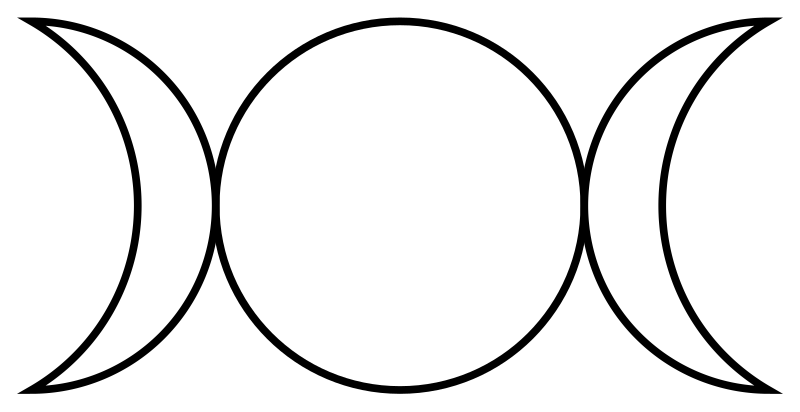
The symbol for the Triple Goddess
GODDESS --  The Goddess is many, one, or both.  It all depends on the person.  There is no set way to worship Her.  She can be the Triple Goddess, Isis, Hera, or any one or combination.  The Goddess is who She is needed to be.  She is life.

To name the Goddess is completely up to the practitioner.  

Symbol for the Horned God
GOD -- The God can be one or many, or all.  He can be the Horned God, Zeus, Odin, or whichever god is preferred.  There is no set way to worship.  He represents the masculine energy.  His power coincides with the Wheel of the Year. waxing in summer and waning in winter.  He symbolizes the death and rebirth.


GREEN MAN -- He is the spirit of the forest. He is symbolized by a human face through foliage. He is known by many names like Jack-in-the-Green or Green Jack.

In, modern day, he's usually part of the spring rites like Beltane or May Day along with the May Queen.

He is the archetypal representation masculine energy in nature.  One theory is that he was a fertility god before becoming the newer Green Man.

The Green Man has been traced back to ancient Rome, but there are cultures with little Roman influence that have a similar figure, including Nepal, Iraq, India, and Istanbul.  In Rome, He may have connections to Dionysus before his image morphed into the hedonistic party animal.  He was a god of agriculture and fertility of nature.

He is found in many churches in Britain in the architecture.  These early churches most likely had pre-Christian believers carving the stonework.  So the pagan tradition survived as the church took over.


Disclaimer: None of these pictures belong to me.  I found them on Google.