Showing posts with label day. Show all posts

Wednesday, April 29, 2015

A to Z Challenge -- Y -- LOG, GRAVEYARD, AND A DAY


YEW -- English Yew is a long lived tree found in many graveyards across Great Britain and many predate the churches, which may have roots in Druid groves.  It was a sacred tree to the Druids.  It was a symbol for immortality, death and rebirth.  It can live for 1000 years or more.  There are estimates that some trees are even 4000 years old!  It is one of the oldest known species of tree. Weapon handles were made from its wood.  Its a poisonous plant.  It has connections to the Otherworld.

YULE -- It is celebrated on the Winter Solstice, around December 21.  It is the rebirth of the God as one of the eight Sabbats of the Wheel of the Year.  Many of the Christmas traditions come from this holiday, including the hanging of mistletoe and the Yule log.

The Yule log was burned to celebrate the the rebirth of the sun.

Many cultures shared this celebration in different forms like the Egyptians, Celts, Norse (Juul), Romans (Saturnalia), and Germanic tribes.

The burning of the Yule log is a tradition that has been carried on for at least a thousand year or more.  A piece from the old Yule log (kept for protection through the year) kindles the new Yule log after a piece is taken from it for the next.  There are certain rituals and superstitions about how the log is decorated and received, but I'm not going to get into them.

YEAR AND A DAY -- December 23.  The Druid lunar months consisted of 28 days in each of the 13 months.  It was used in courts of law.  Mistletoe rules this day, which was called All Heal, Golden Bough and a few other names.

Disclaimer: None of these pictures belong to me.  I found them on Google.

Monday, April 27, 2015

A to Z Challenge -- W -- AQUA, SPOKES, AND NORSE


WHEEL OF THE YEAR -- The Wheel of the Year encompasses the eight Sabbats celebrated: Samhain, Yule, Imbolc, Ostara, Beltane, Litha, Lughnashadh (or Lammas), and Mabon.

The Wheel usually begins with Samhain and the death of the God.  It follows with rebirth of the God.  He grows in power with it culminating at Litha, the Summer Solstice.  Then his power wanes as the darkness of winter grows.

Both the Celts and Anglo-Saxon/Norse have influenced this wheel. Agricultural rites from both ancient cultures are celebrated.


WIDDERSHINS -- To move counterclockwise.  Also called withershins.  Many practitioners do not use this since it is against the sun's direction, but there are some that use it as banishment and destructive use like releasing a circle.


A Symbol for Water
WATER --  Water is one of the four Elements.  It is feminine in nature and is connected to the Goddess.  It's used for psychic workings like scrying, purification, and healing spells.  It's receptive in nature.

The cauldron and cup are associated with this element along with the color blue.


Mercury
WEDNESDAY -- Wednesday is named after the Norse god, Odin, Or if you prefer one of his other names, Wodan.  Translated, his name means master of ecstasy.  He was both a war god and loved to incite war.  He was also a poet god.  He stole the mead of poetry from a giant, which was made from the blood of a human created by Aesir and Vanir spit to cement the truce at the end of the war. (Uh, totally gross.)

His favorite peeps were berserkers and outlaws (for whatever reason) and held favor for a few amazing warriors.

What is more interesting is that in some texts it is said he was a practitioner of seidr, which is a shamanistic practice that rewove destiny.  It was considered a woman's magic and for a man to practice seidr, he was considered unmanly and was looked down upon.  So . . . yeah, interesting contradictions.

The Roman god, Mercury, or Greek Hermes, is also the name for this day.  Dies Mercurii is the root word for the Spanish miércoles.  As god of commerce, messages, luck, thieves, boundaries, roads, travelers, and eloquence, he had his work cut out for him.  What's even more cool is that he also guided departed souls to the underworld.  He was one of the few that could come and go as he pleased.


Disclaimer: None of these pictures belong to me.  I found them on Google.

Thursday, April 23, 2015

A to Z Challenge -- T -- THUNDER, WOLF, AND THREE


TALISMAN -- Talismans are objects charged with personal power.  They are used to attract a specific energy or force.

THREEFOLD LAW -- The Threefold Law is not technically a law per se.  It is more of a defining principle that governs many pagans and wiccans.  It is similar to karma.  Basically what it means is that whatever you send out be it magic workings or whatever will come back on you three times as powerful.

When or how it comes back to the person depends on which variation is believed.  There are several different thoughts on this from cosmic to the more mundane.

Not all use magic practitioners use this principle.  Just like with any religion, there are differences in beliefs in Paganism and Wicca.


TRIPLE GODDESS --  There are many triple goddesses in ancient pantheons.  The Moirai, the Morrígna, and the Norns are a few of them.  These are three individuals that form a group function.  Then there are those with three heads like Hecate at the three-way crossroads.

The Wiccan Triple Goddess is represented by the phases of the moon and are visualized as three different stages of life: Maiden, Mother, and Crone.

There is debate as to whether She is a reincarnation of an older goddess/es or a creation of the Neopagan revival.


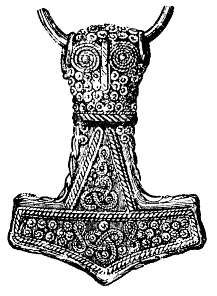
Mjollnir Pendant
THURSDAY --  Thursday is named after the Norse god, Thor.  He was the God of thunder and lightning.  The Romans honored their god Jupiter on this day.  Dies Jovis/Iovis (Jove's day) honors their god of sky and light.  The Greek equivalent is Zeus.

Thor was the protector of humans and gods against evil.  He carried the hammer Mjollnir.  He was one of the most popular of that pantheon.  When the church started to take over, the people began to wear Thor's hammer in defiance.

Jupiter governed over the distribution of laws and used oracles to give the people his will.

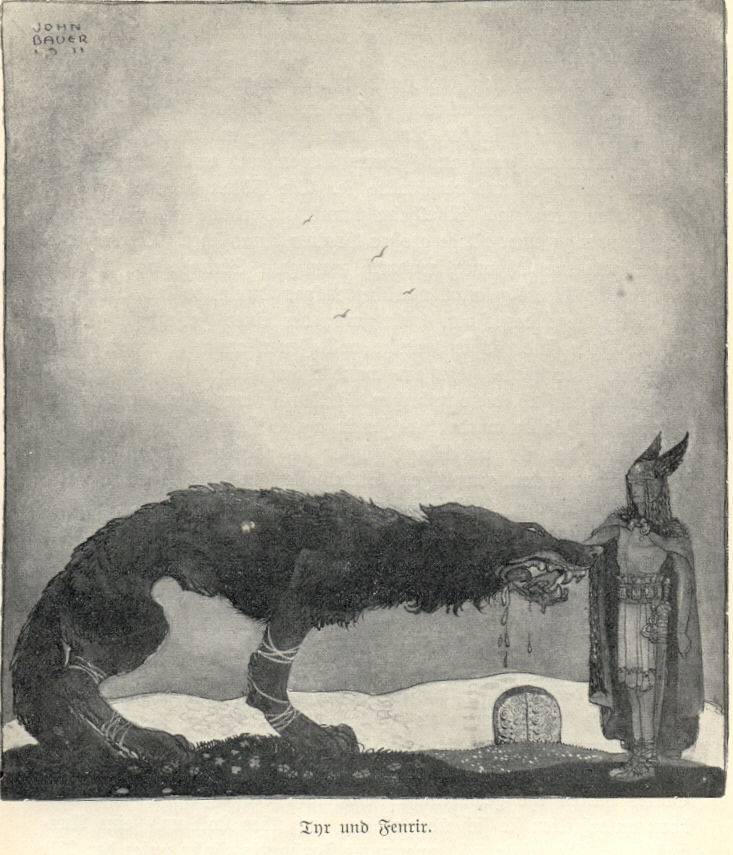
TUESDAY --  Tuesday is named for the Norse god Tyr, which relates to the Germanic god, Tiu (Twia).  The Romans called it dies Martis, which translates to Mars day.

Both Tiu and Mars were gods of war, while Tyr is a defender god.

Tyr, in Norse mythology, was shown to bear only one hand.  The other was sacrificed in the jaws of Fenrir when the gods tricked the wolf son of Loki into chains.


Disclaimer: None of these pictures belong to me.  I found them on Google.

Wednesday, April 22, 2015

A to Z Challenge -- S -- FESTIVAL, MARK, AND WHEEL


SABBAT -- Sabbats are the name for the eight major celebrations in Wicca and Pagan religions.  They consist of the Greater Sabbats and Lesser Sabbats.  The Greater Sabbats are Samhain, Imbolc, Beltane, and Lughnasadh.  These four are the four fire festivals from Pre-Christian times and are when each season is at its peak of power.

The Lesser Sabbats are Yule, Ostara, Litha, and Mabon.  These are the transitional Sabbats when the seasons are turning.  These are the solstices and equinoxes.

SIGIL -- Sigil is defined by Merriam-Webster as:

noun (sig·il) (si-jil)
1: seal, signet
2: a sign, word, or device held to have occult power in astrology or magic

It comes from the Latin and means a mark, sign, or seal.

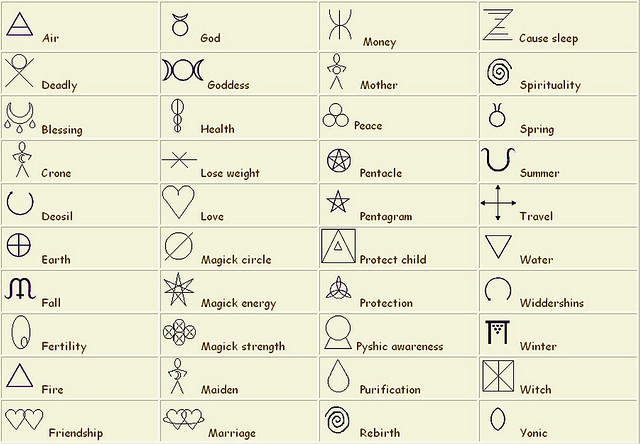
In Wicca, sigils are said to very powerful and are designed with elements that have specific meanings. They sometimes start as a sentence of intent and are created specifically to will it into being. They can be inscribed onto objects like candles, talismans, amulets as well as other things.  They can be used for many purposes like protection.

 Sigils can be abstracts that are very personal to the creator and can have no meaning to anyone else, or they can be made of other symbols put together or even letters from the sentence of intent.  

Historically sigils have been the equivalent of the true name of spirits and were used as such in the medieval magic.  Some pratictices involved summoning angels and demons through their sigils.  

Many other cultures have used sigils like the Hebrews.  Their word is segula has a few meanings including talisman, folk remedy, safeguard, or superstitious action. 


The sun cross
SUN --  The sun has been worshiped since man walked the earth.  Every ancient culture has some form of sun worship.  The Egyptian Ra, the Greek Apollo, the Celtic Lugh, and the Japanese Amaterasu are just some of the gods and goddesses associated with the sun.

For Many Wiccans, the Wheel of the Year is a representation of the eight Sabbats that follows the God's birth and death as the sun.  Within the Wheel is the sun cross, which divides the Sabbats into their quadrants.


SKYCLAD -- This is the proper term for ritual nudity.  It has absolutely nothing to do with anything sexual.  It is not a requirement at all.  


SAMHAIN -- (pronounced sah-win, sow-in, sah-vin) is a Celtic word that means "summer end".

It is a the beginning of the Wheel of the Year and heralds the third and final harvest before winter.

This is the time when the Goddess is in Her third aspect, the Crone.  She is symbolized by the waning moon.  It is said that the God dies before He is reborn at Yule, the Winter Solstice.  It is when those who have gone before are remembered.

It is believed that the veil between the worlds is thinned and that the dead could roam freely on the Earth.  One tradition during this time was called the Dumb (Silent) Supper.  As a sign of honor, a place was set at the table for the departed.  The plate was filled with food for their spirit guest.  The supper would be completely silent. It was believed that looking at the chair was bad luck.  Also, to placate any evil spirits roaming around, food was placed on the doorstep to ward them off.


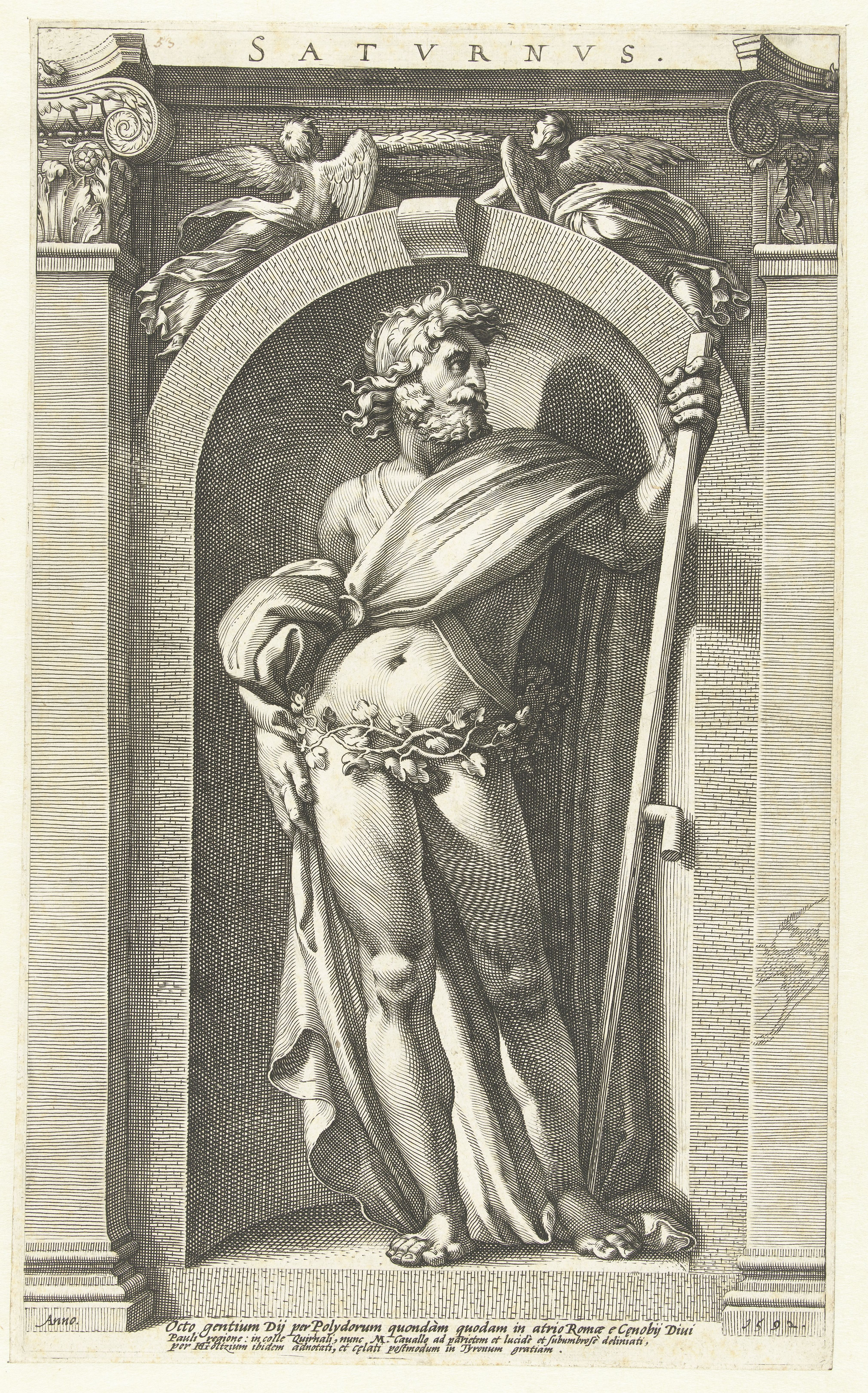
Saturn

SATURDAY --  This day of the week is named for the Roman god Saturn.  He is the god of sowing seeds and later of time.  He was once the supreme ruler of the gods after his father and before his son, Jupiter.  He is equated with Cronus in Greek mythology.  His festival, Saturnalia, fell on December 17.  It was the most famous of all because this festival was the IT festival.  Slaves were free to speak and sit with their masters as well as be served by them.  Gifts were exchanged, which may have influenced Christmas.  A 'king' was elected by dice game and was given the power over his 'subjects' and could request them to do ridiculous things. 

Saturn may have roots as an underworld god that held sway over funerary rites.  this can be surmised by his first consort, Lua.  She was a goddess that soldiers sacrificed captured weapons to avoid misfortune.


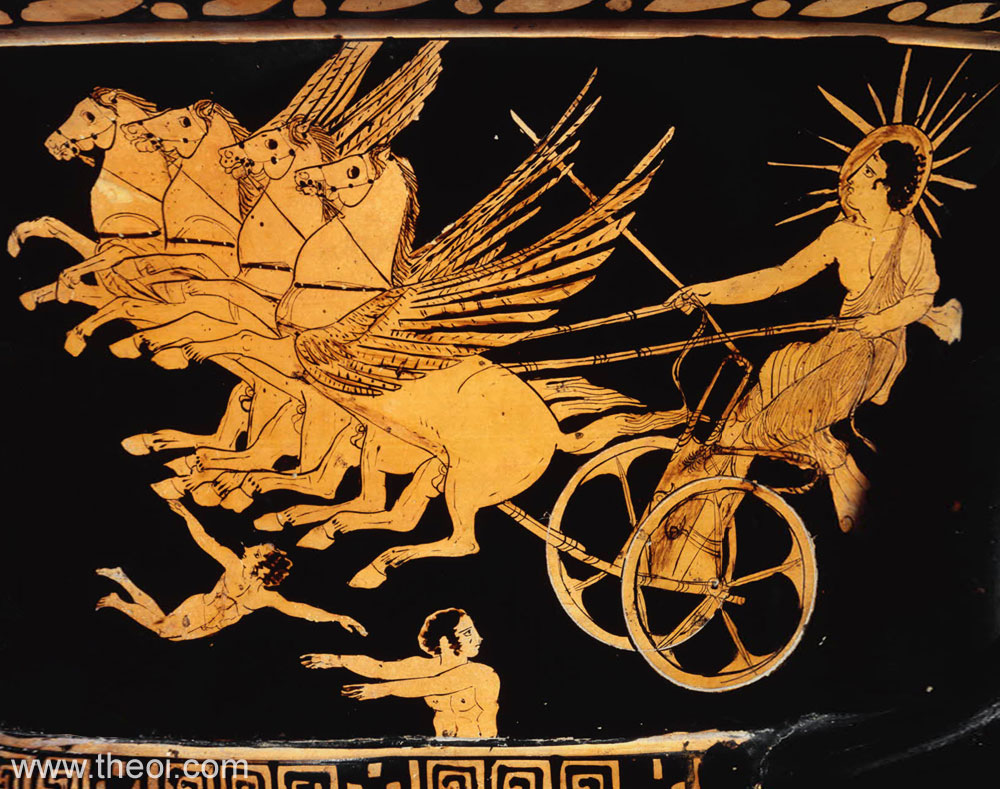
Helios

SUNDAY -- Sunday comes from the Latin dies solis.  It means day of the sun.  The Roman god, Sol, was similar to Helios. In many of the Romance languages it has been changed into a word that translates to "the Lord's day".  Also, to note, that in Norse mythology, the sun was a goddess called (shall we guess? That's right!) Sól!  Her brother was the moon. They were chased across the sky by wolves until Ragnarok. 


Disclaimer: None of these pictures belong to me.  I found them on Google.

Wednesday, April 15, 2015

A to Z Challenge -- M -- HUNTER, CRESCENT, AND FULL


MABON -- This Sabbat falls on the Autumn Equinox.  It is the second harvest.  The God grows old and is preparing for his death at Samhain.

The stories of Mabon ap Modron, the Welsh God, and of Demeter and Persephone are associated with this time.

Dionysus, the god of wine and revelry, is also a fertility god and of the the harvest.  One myth about him, tells how he was destroyed by the Titans, except his heart, and was resurrected when Zeus gave the heart to Semele to eat, whereupon she gave birth to him anew.  This reflects the same cycle seen in the Wheel of the Year.


MAIDEN --  The first aspect of the Triple Goddess in Wicca.  She is represented by the waxing crescent moon.  She is fresh and youthful and in the first blush of womanhood.  Associated with Spring, the Maiden is beginnings and ideas, potential, and newness.


MALLEUS MALEFICARUM -- Translated it means the The Witches' Hammer.  Written in 1484 by Heinrich Kramer and James Sprenger, two Inquisitors.  Under the Bull of Pope Innocent VIII, this document was a guide to questioning, when torturing was necessary, trying, and sentencing those accused of witchcraft.  It also included how to spot signs of witchcraft and demon possession, how to cure those inflicted with spells, how to protect themselves from spells, and a host of other information for the professional witch hunter, Inquisitor, or magistrate.  It was in use for three centuries or so in the persecution of those falling within their grasp.


MARCH -- March began the Roman year.  It was when military campaigns renewed after the break in winter.  Martius translates to (month of) Mars.  Mars being the Roman god of war.


MAY -- Named after the Roman goddess Maia, who is the goddess of spring growth.

MOTHER --  She is the second aspect of the Triple Goddess.  She is in her prime in all things: fertility, ripeness, sexually, and power.  Most times, She is pictured pregnant to symbolize this richness.  The full moon represents Her.

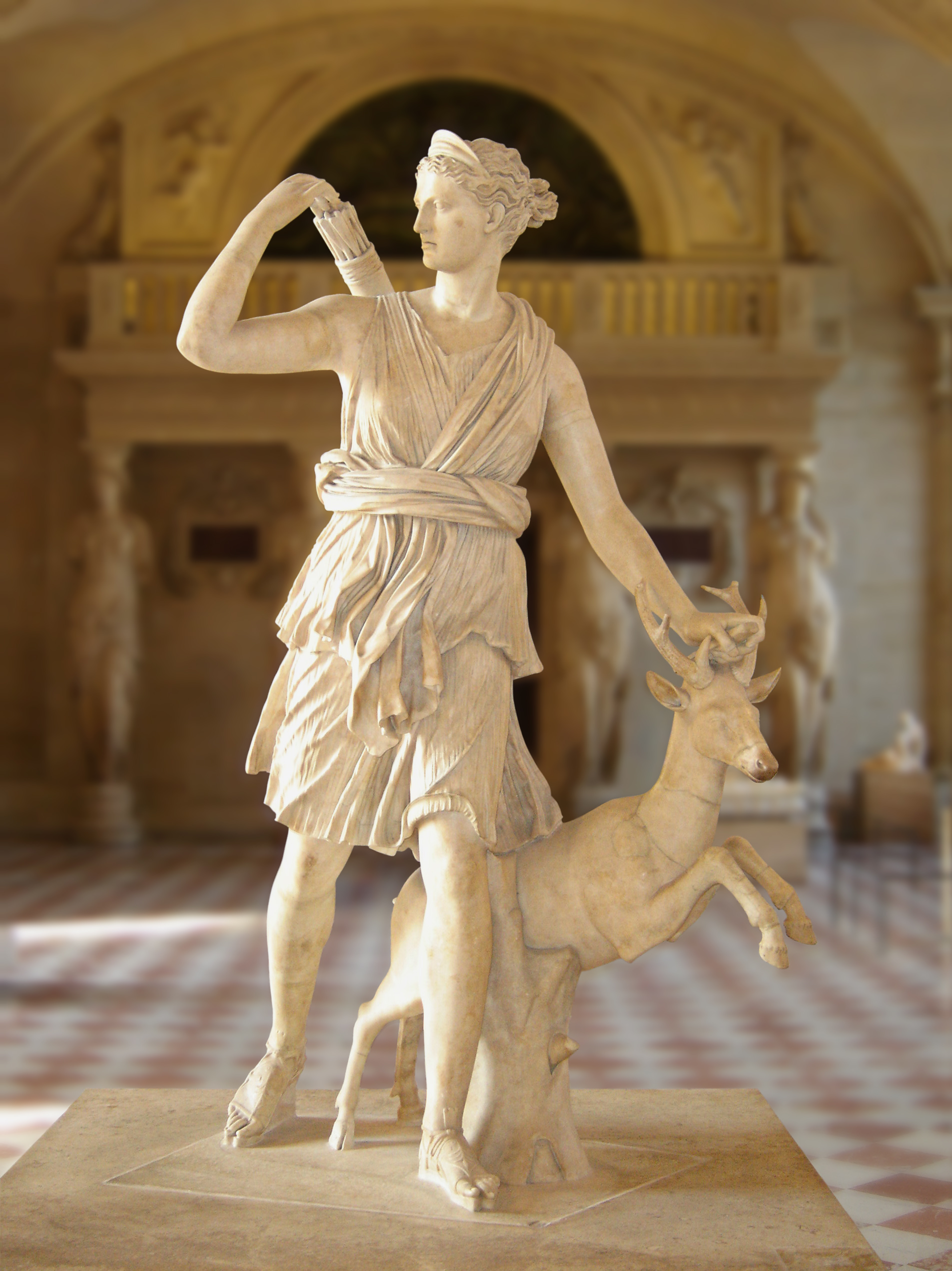
Diana
MOON --  The moon has been studied, worshiped, and used as a means of time telling for just about every ancient culture. Many used/still use the lunar calender, including Ancient Egyptians, Chinese, and Greeks to name a few.  Others used or changed to a lunisolar calender.

The varying gods and goddess for the moon run across all the mythological pantheons: the Egyptian Thoth, the Roman Diana, the Greek Selene, and the Japanese/Shinto Tsukuyomi-no-Mikoto.

Many modern day Wiccans have the Triple Goddess or the Maiden, Mother, and Crone.  The Maiden is the waxing moon, the Mother is the full moon, and the Crone is the waning moon.


MONDAY --  The name of this day comes from the Old English monandaeg from the Latin dies Lunae,which translates to day of the moon.


Disclaimer: None of these pictures belong to me.  I found them on Google.

Tuesday, April 14, 2015

A to Z Challenge -- L -- SOLSTICE, AXE, AND HARVEST


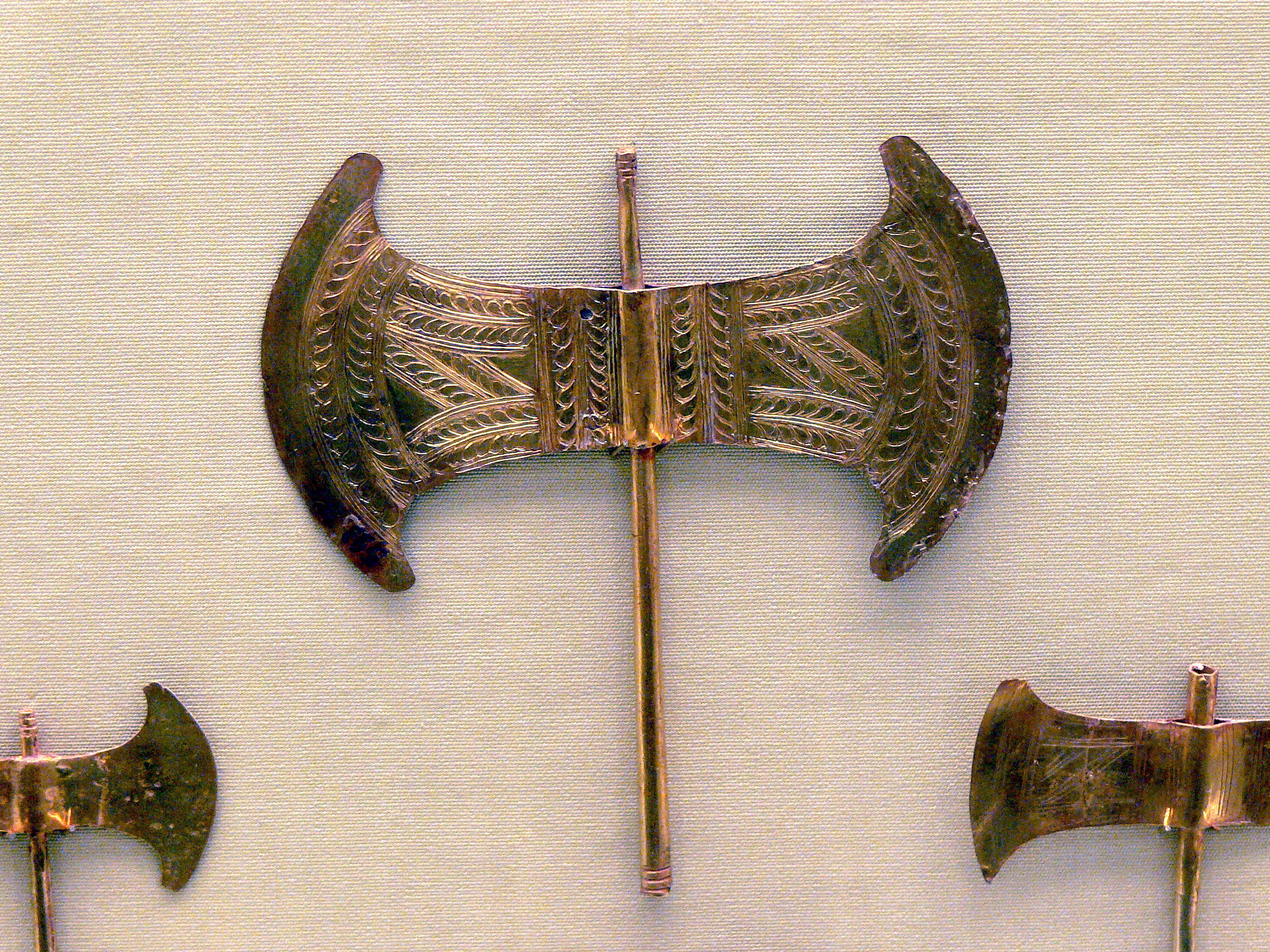
LABRYS -- The double-head axe that symbolizes the Goddess in some modern practices, but the labrys has a much older history.

In ancient Crete, the labrys was one of the holiest symbols.  It's surmised that in the Minoan culture it was a symbol of the Great Goddess. In depictions of the labrys, a woman always held them until the decline of the culture.  Then it was taken over by the Greek god Zeus.

The word labyrinth has etymological roots to the labrys as well.  The labyrinth may have a religious significance to the Minoans.  As does the bull.

The story of Theseus and the Minotaur in the labyrinth comes from these things being corrupted by the Greeks.

We may never know the full history Minoan culture and its influence on other peoples since much of their civilization is lost to time.


LADY/LORD --  Generic salutations for the Goddess and God.


LITHA -- A Sabbat that takes place on the Summer Solstice.  It is also known by the names Midsummer and Alban Heruin.  It is when the God is at his full power.  It is a turning point in the Wheel of the Year because He will lose his strength as darkness begins to return.  The Goddess blooms in pregnancy.

The land is at its greatest fertility, so marriages and magic rites are prevalent during this time.  Flowers and greenery are decorations. Bonfires are plentiful since this sabbat is connected with the God. Some leap over them to encourage fertility, purification and such.

We get the word honeymoon from marriage celebrations during this time.  The honey moon, or mead moon, where a newly married couple would drink mead everyday for a month.

The Romans celebrated Vestalia around this time.  It honored the goddess Vesta, the patron goddess and protector of virgins and the of the hearth.  She was Hestia to the Greeks.

She was not usually portrayed by statuary but was symbolized by a sacred fire. Bakers and millers honored this day by dressing their tools and animals with garlands.  The ass, Vesta's animal, was also honored.  Only women were allowed into the temple at this time to worship.  They made offerings to Vesta.


A Corn Doll
LUGHNASADH -- This sabbat is the celebration of the first harvest, taking place around July 31 or August 1.  It is when the God has aged.  The sun wanes and the fields give up their bounty.

Lughnashadh (pronounced ) was named after the sun god, Lugh.  In Irish mythology, he created a festival to honor his dead foster mother Tailtiu.  The funeral feast and games inclued match making and trade.

In later times, corn dollies were made (and still are) made of the last sheaves of corn or whatever grain was harvested.  They represented the spirit of the grain.

Also called Lammas, which translates to 'loaf mass'.  It was the medieval celebration of first harvest.

Grain has been a key worshiping tool for all ancient cultures.  They may vary in traditions, but they all knew the importance of their harvests and wanted to keep the local gods/goddess appeased and the land fruitful.


Disclaimer: None of these pictures belong to me.  I found them on Google.

Tuesday, April 7, 2015

A to Z Challenge -- F -- WOLF, GODDESSES, AND FLAMES


FAMILIAR -- Familiars can be animal of the physical or astral plane.  It can be a spiritual ally. Familiars are very distinct and individualist to a coven or practitioner.  They can help raise energy in a circle.  A bond exists between the the familiar and the individual.

Similar beings from shamanic teachings and other ways.  Totems, animal guides, and spirit guides are only a few of the names.

There are subtle differences between all of them, but it basically boils down to:  a physical or nonphysical entity that guides and protects.

They were demonized by the church.


FEBRUARY -- The name February comes from Latin origins.  It is comes from the Roman month Februarius or "of Februa".

During this time around the 15th, a festival called Lupercalia was held. Presided over by the Luperci (brothers of the wolf, a sect of priests).  This festival incorporated the story of Romulus and Remus, the twin founders of Rome.  It honored the she-wolf that suckled them as infants.

Luperus (Pan for the Greeks) was the god associated. The februa were strips of goat skin that were smacked against the people.  For women and girls, to be hit by one was an insurance that they would be fertile.  So it was also a fertility rite.

Later the Februalia was also incorporated.  This was a ritual purification associated with washing with water since spring was a very rainy time of year.


FIRE -- Fire is one of the four Elements.  It's cardinal point is South.  Fire is associated with the color red.  Candle, sun, love magic are all represented by fire.  It is masculine and a projective element.  It is both a destructive and rejuvenating element.  Fire magic is used to banish negative influences in your life or to purify.  The incense censor is the tool usually associated with it, but a candle is used to represent the element upon the altar.


“Freyja and the Necklace” by James Doyle Penrose (1890)
FRIDAY -- Friday is named for either the Norse goddess Frigg/Frigga, Odin's wife and goddess of marriage, love, and destiny or for the Norse goddess Freya/Freyja.  She is the goddess of love, sexuality, war, death and a few other things as well.  She also received half the dead collected.  They went to Fólkvangr.  Odin received the other half who went to Valhalla.

There is debate as to whether Frigg and Freya had a common link or are the same goddess earlier in the history.


Disclaimer: None of these pictures belong to me.  I found them on Google.